Quality Control guide
WORK IN PROGRESS
Introduction
The purpose of this section is to provide advice on how to perform quality control (QC) on raw MRI data for clinical research studies, specifically focusing on anatomical and functional MRI data. The idea is to suggest a visual QC approach, ideally using existing software that generates quality reports and metrics (e.g., MRIQC software).
There are various methods for conducting QC on raw data and this section is juste one proposition. The most crucial aspect is to closely examine the data to better understand them and accurately interpret the analyses.
QC of raw data can be time-consuming and tedious for large databases. Several initiatives for automatic QC have been/are being developed, but for the moment there is no consensus and the tools are often specific to a cohort.
Resources (bibliography, software) can be found at the end of the section.
General advices
-
During the acquisition of an MRI sequence, various issues may arise and may affect image quality. These can include artifacts related to the MRI scanner, image reconstruction issues, or choices made during acquisition (e.g., incorrect field of view). Additionally, there may be physiological artifacts related to the patient (e.g., movements). Performing quality control on the data helps identify data that should be excluded because they could interfere with the analyses. The goal is to determine whether the image can be used to answer the study's questions.
-
Ideally, an initial data check should be performed during acquisition to potentially redo any problematic sequences (if possible). For example, if a subject moved significantly during one of the main protocol sequences, it might be more useful to redo that sequence rather than completing the optional sequences (if there are any).
-
A "good data" from a quality control perspective does not necessarily mean that the chosen sequence is suitable for the intended application. The selected parameters may be inadequate for the planned analyses (e.g., significant signal loss in the area of interest due to the chosen parameters). Therefore, it is important to discuss with an MRI physicist before starting acquisitions to properly set up the sequences and conduct pilot subjects. If a particular area is crucial for data analysis (e.g., if fMRI activation is expected in this area or, for anatomicatl data, if this area should be segmented), it is useful to add an exclusion criterion based on the quality of that specific area.
-
Currently, there is no consensus on how to perform QC; there is no single "correct way" to conduct QC (different tools, methodologies, and sometimes different definitions for quantitative values). Some rejection criteria for an image may depend on the study and the analyses to be performed. To maintain consistency in quality control, it is important to follow the same QC steps within the same study.
-
It is sometimes useful to use pre-processing to perform QC on raw data because it helps to better understand the data. For example, for an anatomical sequence, it might be useful to check if the segmentation of white/gray matter is done correctly. For a diffusion sequence, it might be useful to look at reconstructions maps like fractional anisotropy (FA).
-
This section focuses on image quality, but for functional MRI data, it is also useful to have a method for verifying if the subject performed the task correctly/if the measurements were properly recorded.
-
It is important to document the QC steps and results in an understandable manner to share the QC results along with the data (in an Excel file, for example).
Verification of the data "integrity" and of the parameters
The first step is to verify the "integrity" of the data, meaning ensuring that the data is ready for analysis.
Here is a non-exhaustive list of things that are useful to check:
-
Verification of the database consistency in terms of subject identifiers and session dates.
-
Verification of the sequences received per subject (do all subjects have all the sequences of the protocol? The mandatory sequences? Are any sequences duplicated?). It is useful to document this information (in an Excel table, for example).
-
Checking that the DICOM files are complete. In "classic" mode, a DICOM file is generated for each acquired image (slice, dynamic, echo, etc.) and so there are several DICOM files for one sequence. In "Enhanced" mode, a single file is generated for each sequence (with a certain size limit). In classic mode, it is possible that an export or transfer error results in missing some DICOM files, and thus some images. It may be useful to check the size of the images converted to NIfTI to highlight such problems. This check can also be done during the visual inspection of the images.
-
Verification of the main acquisition parameters. Some parameter modifications may have been made during the course of the study and may influence the analyses (e.g., modification of repetition time following an upgrade of the MRI software). Here is a non-exhaustive list of the parameters that may be useful to check: echo time, repetition time, voxel size, number of repetitions for functional MRI, parallel imaging... Depending on the sequence, certain parameters are more important to check than others.
QC of anatomical and functional data with MRIQC
In this section, we propose to use MRIQC software to perform QC of anatomical and functional data. The idea is to use the visual report provided by MRIQC. However, it may be useful to open the image in a specific viewer in case of doubt about image quality, or to check the different dynamics of a functional sequence.
To use MRIQC check out the documentation here or directly the MRIQC documentation.
Once the MRIQC's results are available, for each subject, open the MRIQC report (explanation can be found here).
The report contains several mosaics (mean signal, zoomed-in on the brain, image with background noise enhancement...). For functional data, there's also a summary graph, including a plot for framewise displacement (FD) and a carpetplot. The FD represents the displacement of the subject's head. Each line of the carpetplot represents the value of a voxel over time (separated by region).
Check each mosaic and graph. Check whether any of the criteria proposed and detailed below are present and whether this should lead to the exclusion of the data for analysis.
Very often, certain artifacts are present on the image but do not imply that the image should be excluded. In such cases, it may be useful to report the presence of the artifact anyway.
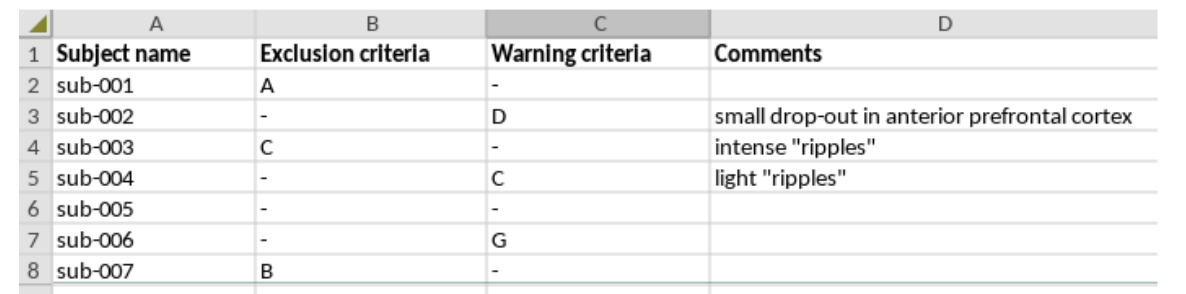
One solution is to report the information in an Excel spreadsheet, with a column for reporting excluding criteria and a column for non-excluding criteria (and comments, if needed):
In case of doubt or if the visual report is not precise enough, open the image in a specific viewer and review the different slices / dynamics.
Structural T1w MRI
In this section, we consider a non-contrast T1 anatomical sequence.
We propose a list of criteria that may lead to the exclusion of an anatomical image. This list may need to be adjusted according to the study criteria and the planned analyses. If a specific area is critical for the study (e.g., the hippocampus, if the study aims to segment the hippocampus), it may be useful to add a QC criteria for this area ("is there an artifact in this area?").
Some criteria are based on the mosaics available in the MRIQC report (alignment in MNI, segmentation, etc.). Other criteria can be used by simply viewing the image in a viewer.
Proposed Quality Control criteria:
| Descriptions | |
|---|---|
| A | Gadolinium-injected sequence |
| B | Non-compliant brain coverage according to the protocol or abnormal subject positioning (subject rotation) |
| C | Significant movement artifacts (“wrinkles” or “blur” or cortex duplication) or in a critical area for the study |
| D | Significant signal loss (susceptibility artifact) or in a critical area for the study |
| E | Eye artifacts spill over to the brain |
| F | Significant non-uniformity of intensity (bias inhomogeneity) |
| G | Background noise or folding ghost artifact with an impact on the brain |
| H | Very low gray/white matter contrast |
| I | Inconsistent segmentations |
| J | Poor alignment in MNI |
| K | Unexpected anatomical anomalies/pathologies not covered by the protocol |
| L | Other artifacts |
How to check each criteria is detailed below with examples.
A. Gadolinium-injected sequence
Look at the first mosaic ("Zoomed-in mosaic view of the brain") in the report.
/!\ When you're not an expert, it can be very difficult to see the difference between injected and non-injected sequences.
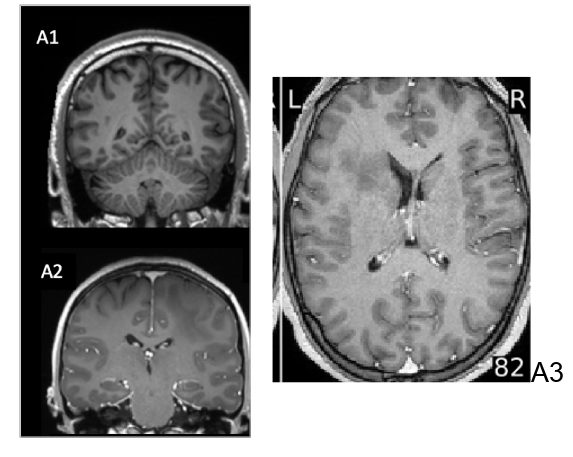
Figure : A1: T1W without gadolinium A2: Gadolinium-injected T1w (from https://doi.org/10.1016/j.media.2021.102219.) A3: Gadolinium-injected T1w.
B. Non-compliant brain coverage according to the protocol or abnormal subject positioning (subject rotation)
/!\ In the case of certain studies, total non-coverage of the brain may be deliberate, so check the acquisition protocol.
Look at the first mosaic in the report ("Zoomed-in mosaic view of the brain"), in particular the extreme sections (bottom and top of the brain) and the sagittal mosaic, which allows you to quickly see whether or not the brain is fully covered.
C. Significant movement artifacts (“wrinkles” or “blur” or cortex duplication) or in a critical area for the study
Look at the first mosaic ("Zoomed-in mosaic view of the brain") in the report.
Head movements during acquisition result in the appearance of lines that are rather concentric ("wrinkles" / "ripples") or a "blur" or duplication in the cortex. Movement can be visible either throughout the image or in just a part of it. Depending on the planned analysis on the anatomical sequence, it may be acceptable to keep sequences with slight movements.
It is important to know the areas of interest in the study (or the subjects' pathology). For example, if the aim of the study is to segment the hippocampus, movement artifacts in the hippocampus will require the image to be excluded, whereas movement artifacts in the cerebellum will not.
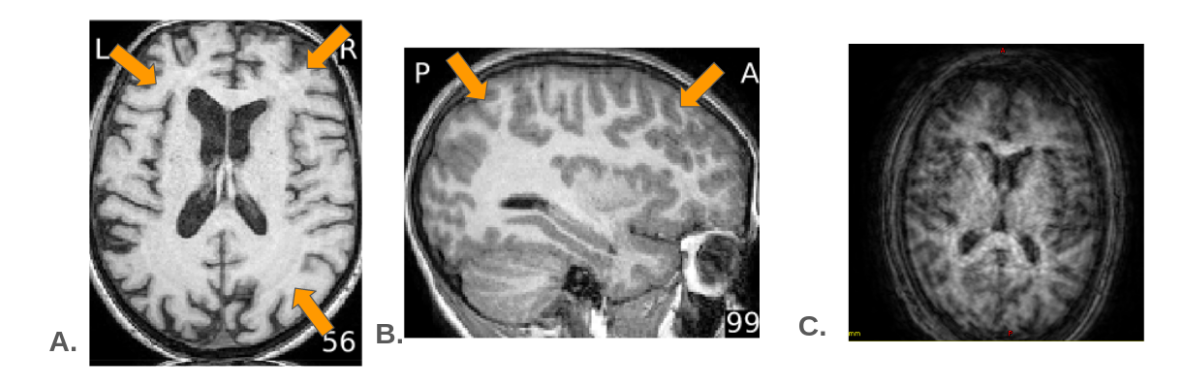 Figure: A and B: Wrinkles, the image is not necessarily to be excluded, it depends on the analyses planned C: Movement is very important (wrinkles + blur), to be excluded if segmentation analyses are to be carried out.
We can also sometimes observe a so-called "Gibbs" artifact (truncation artifact), which is sometimes difficult to distinguish from motion (which is why it is discussed here in the same exclusion criteria). This artifact generates fine lines at high-contrast interfaces.
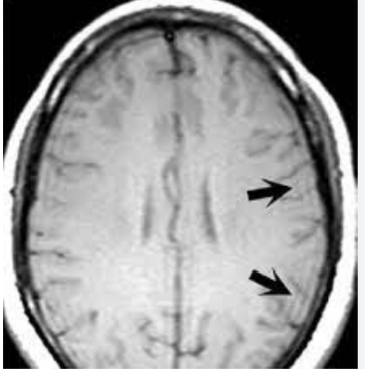
Figure: Gibbs artifact (from https://doi.org/10.1007/978-3-030-85413-3_102)
D. Significant signal loss (susceptibility artifact) or in a critical area for the study
Look at the first mosaic in the report ("Zoomed-in mosaic view of the brain").
Susceptibility artefacts due to the non-uniformity of the field are mainly present at air/tissue interfaces or close to metallic objects and result in a loss of signal. The regions most affected are the prefrontal cortex and the region near the ear cavities.
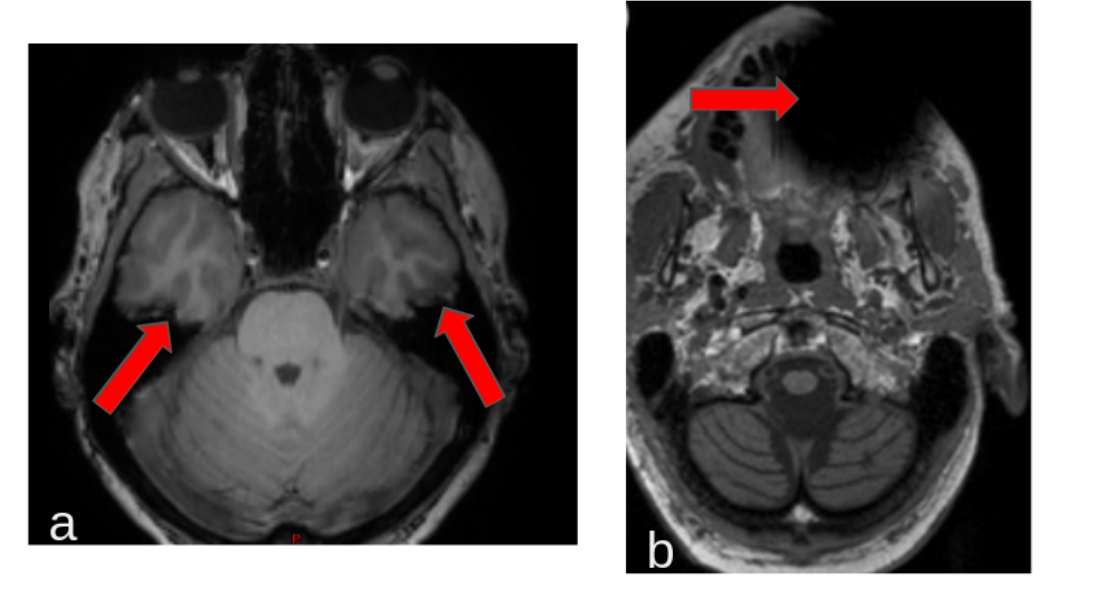
Figure: a. Very slight susceptibility artefact near the ear cavities (the brain appears to be slightly nibbled), there is no need to exclude the image. b. Susceptibility artefact near the teeth caused by a metal object. This does not affect the brain, there is no need to exclude the image
E. Eye artifacts spill over to the brain
Look at the first mosaic in the report ("Zoomed-in mosaic view of the brain").
If there are strong eyes movements, an overlap of the eye signal in the brain may be observed. If the overlap is strong and/ or impacts regions of interest, it may be necessary to exclude the image.
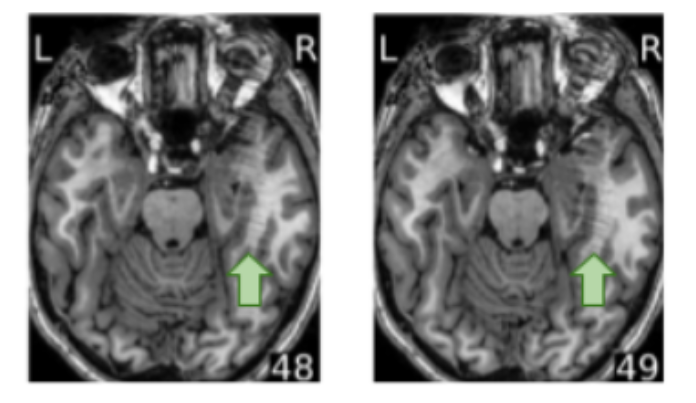
Figure: Eye artifacts spill over to the brain (green arrow) (from https://doi.org/10.1016/j.media.2021.102219)
It is also possible that the eyes movements are visible only in the background of the image without impact on the brain, in this case it seems not necessary to exclude the image.
F. Significant non-uniformity of intensity (bias inhomogeneity)
Look at the first mosaic in the report ("Zoomed-in mosaic view of the brain").
This non-uniformity is characterised by a variation in intensity in the brain, for example the white matter will be darker in the anterior regions than in the posterior regions of the brain.
There is always a slight bias inhomogeneity on the T1w image. This inhomogeneity can be corrected during post-processing. However, if it is too strong, the correction will not be sufficient and segmentation of white and gray matter with software such as SPM may be problematic. The image may be excluded if the bias inhomogeneity is too strong. This may be due to an issue with the coil.
G. Background noise or folding ghost artifact with an impact on the brain
Look at the "Zoomed-in mosaic view of the brain" and "View of the background of the anatomical image" mosaics.
The term "aliasing ghost" is used when the background noise is structured and appears as a shifted repetition of the brain. The image should be excluded if it spills over into the brain.
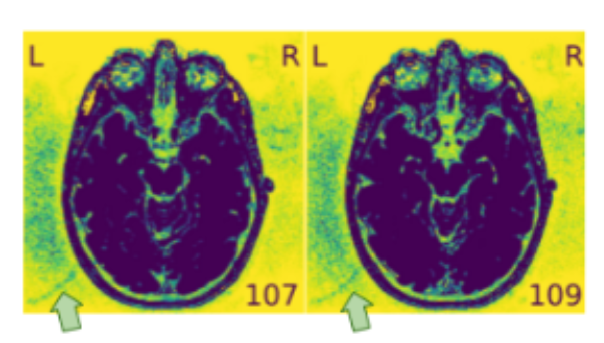
Figure: Aliasing ghost (a shifted repetition of the brain appears in the background). It does not seem to impact the brain, it is not necessary to exclude the image (from https://doi.org/10.1016/j.media.2021.102219)
H. Very low gray/white matter contrast
Look at the first mosaic in the report ("Zoomed-in mosaic view of the brain").
If the contrast between the white and the grey matter is too low, segmentation with software such as SPM may be problematic. In extreme cases, it may be better to exclude the image from the analyses.
I. Inconsistent segmentations
Look at «Brain extraction performance», «Head mask», «Brain tissue segmentation» mosaics.
If the tissue segmentation is not consistent, this may indicate potential issues when segmenting with automatic software. It will be necessary to check carefully the outputs of the segmentation performed in the analyses before using them.
Note that, in the MRIQC report, the head mask often appears to be inconsistent specifically near the teeth and at the top of the brain.
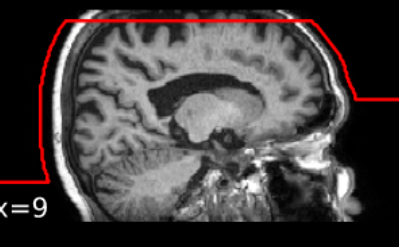
Figure: The head mask compute by MRIQC is inconsistent. However, it is not necessary to exclude the image
J. Poor alignment in MNI
Look at the «Spatial normalisation of the anatomical image» in order to check the MNI realignment.
If the realignment in the MNI space is not consistent, this may indicate potential issues when using automatic software. As the normalisation in the MNI performed in MRIQC is a quick and "dirty" normalisation, it may not be necessary to exclude the image but it will be necessary to check carefully the outputs of the normalisation performed in the analyses before using them.
K. Unexpected anatomical anomalies/pathologies not covered by the protocol
Look at the first mosaic in the report ("Zoomed-in mosaic view of the brain").
This may reveal anomalies not anticipated by the protocol (tumor, trace of a stroke).
/!\ Note that it is not the role of a non-medical person to detect anomaly and that it is difficult to "name" the anomaly correctly without special medical training. The aim of this stage is simply to exclude images with anomalies that could cause problems in the subsequent analyses and/or to exclude subjects (for example if we want to make an atlas of healthy subjects). This step is in no way a diagnosis and should not be communicated to the subject without medical advice. In case of doubt, contact the doctor in charge of the study.
L. Other artifacts
Other artefacts may be present and potentially lead to the exclusion of an image. If this is the case, add a note of the problem in the comments section.
Functional EPI MRI
In this section, we consider a functional MRI obtained with an EPI sequence.
For fMRI acquisitions, we want to to obtain the highest signal-to-noise ratio (SNR) and contrast-to-noise ratio (CNR) while minimising the various artefacts.
Artefacts may be related to the pulse sequence used, the equipment (antenna/gradient) and the subject (head movements, cardiac and respiratory 'noises'...).
Some artefacts are characteristic of EPI sequences:
-
Spatial distortions due to inhomogeneity of the static field (susceptibility artefact). They are more significant as the field strength increases. These distortions appear locally in the form of stretched or compressed pixels along the phase encoding axis. It is possible to correct some of these distortions retrospectively.
-
Signal losses due to field inhomogeneities (susceptibility artefacts) near air/tissue interfaces. Some acquisition parameters can help to reduce these signal losses (choice of an appropriate TE, increase number of slices...).
-
Phantom images in the phase encoding direction. These are due to the fact that the odd and even lines in k-space are acquired with opposite polarity. Certain acquisition techniques can help to reduce the extent of these effects.
We propose a list of criteria that may lead to the exclusion of an functional image. This list may need to be adjusted according to the study criteria and the planned analyses (specific ROI...).
Some criteria are based on the images available in the MRIQC report (mean signal, standard deviation map, alignment in MNI, carpet plot, etc.). Other criteria can be used by simply viewing the image in a viewer.
Proposed Quality Control criterion:
| Descriptions | |
|---|---|
| A | Non-compliant brain coverage according to the protocol or abnormal subject positioning (subject rotation) |
| B | Significant signal loss (susceptibility artifact) or in a critical area for the study |
| C | Excessive spatial distortions of the brain (susceptibility artifact) |
| D | High number of black slices, outliers, or hyperintensity in a slice |
| E | Significant movements or in a critical area for the study |
| F | Aliasing artifact that impacts the brain |
| G | Background noise or ghost artifact with an impact on the brain |
| H | Unexpected anatomical anomalies/pathologies not covered by the protocol |
| I | Other artifacts |
How to check each criteria is detailed below with examples.
A. Non-compliant brain coverage according to the protocol or abnormal subject positioning (subject rotation)
/!\ In the case of certain studies, total non-coverage of the brain may be deliberate, so check the acquisition protocol.
Look at the first mosaic in the report ("Voxel-wise average of BOLD time-series, zoomed-in covering just the brain") and especially the extreme slices (bottom and top of the brain) and the sagittal mosaic, which allows you to see quickly whether or not the area covered by the study is entirely covered.
A bad coverage can be problematic for the normalisation of the image in a common space such as the MNI (see "Spatial normalization of the anatomical image" mosaic). Note that, in MRIQC, the normalisation performed is "quick and dirty" (without using anatomical image). If the normalisation is bad in MRIQC, it will be necessary to check carefully the outputs of the normalisation performed in the analyses but not necessary to exclud the image.
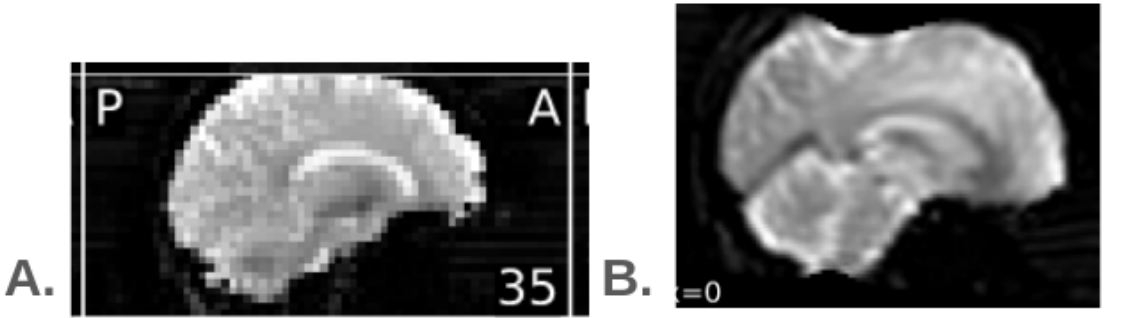
Figure: A: The top of the brain is cut, maybe not necessary to exclud the image B: Impact on the normalisation in MRIQC(MNI space)
B. Significant signal loss (susceptibility artifact) or in a critical area for the study
Look at the first mosaic in the report ("Voxel-wise average of BOLD time-series, zoomed-in covering just the brain").
The signal losses impact the areas near air/tissue interfaces or close to metallic objects. The regions most affected are the prefrontal cortex and the region near the ear cavities.
It could lead to image exclusion if the signal loss impact a big region or a region of interest for the study.
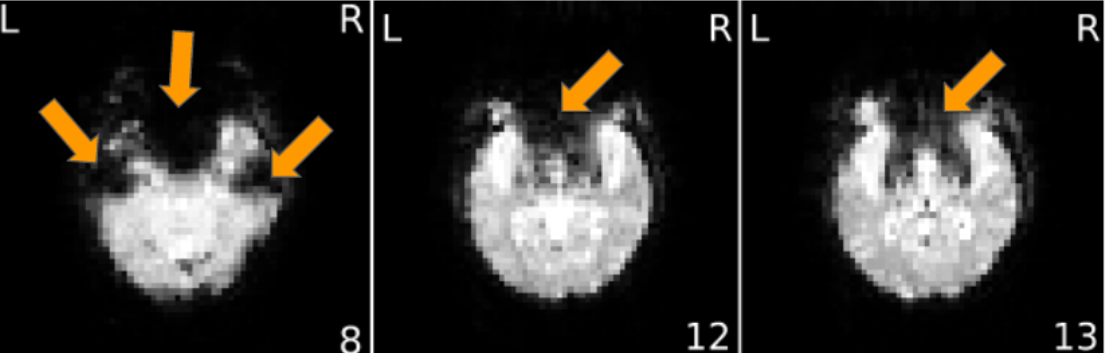
Figure: Example of an image with an important signal loss on several slices
Some brain anomalies (as cavernome) can also lead to signal loss.
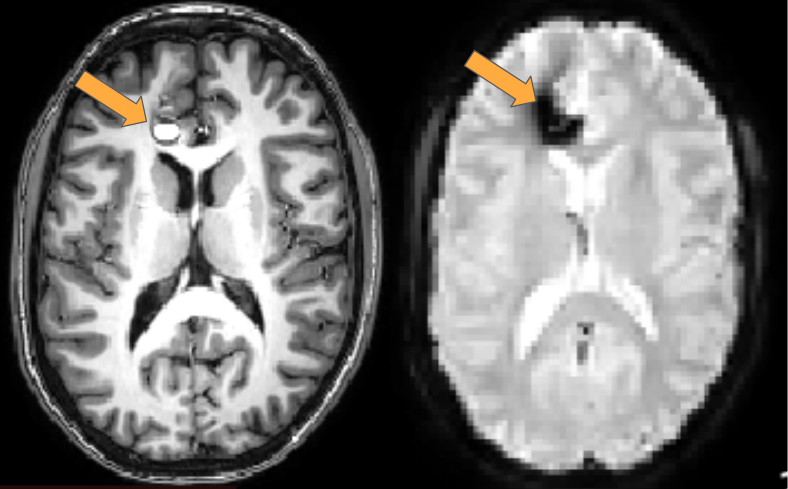
Figure: Example of an image with a brain anomalie that leads to a signal loss
C. Excessive spatial distortions of the brain (susceptibility artifact)
Look at the first mosaic in the report ("Voxel-wise average of BOLD time-series, zoomed-in covering just the brain").
Spatial distortions of the brain due to susceptibility artifact appear locally in the form of stretched or compressed pixels along the phase encoding axis.
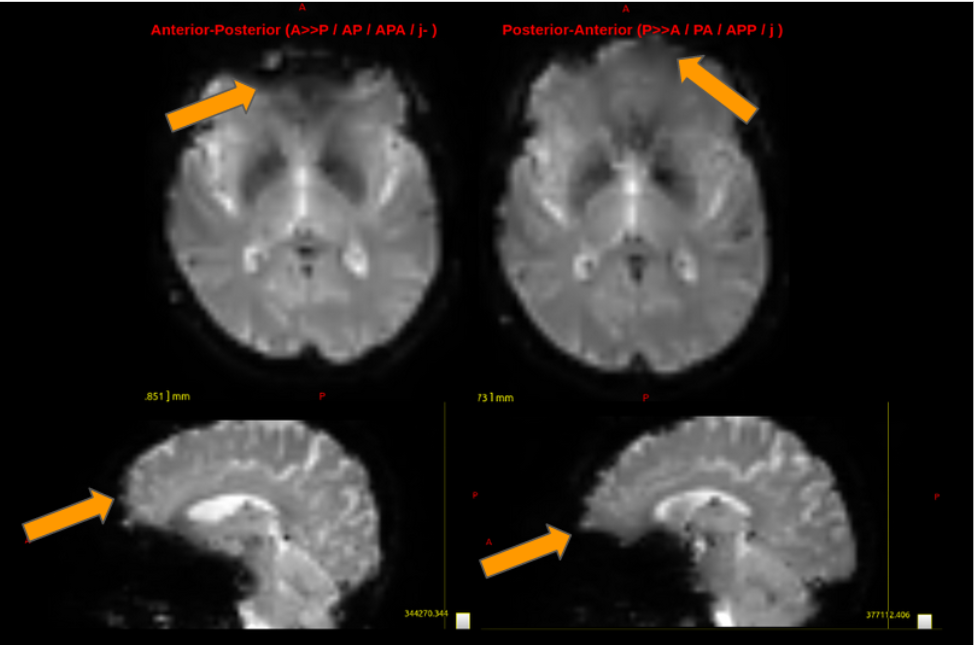
Figure: Data acquired with two inverse phase encoding direction (to the left antior-posterior and to the right posterio-anterior)
These distortions can be corrected using a field map. This may be an exclusion criteria if the distortions are too important and/or if no field map is available to correct these distortions.
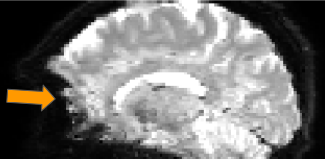
Figure: Example of distortion on an image acquired with a phase encoding direction in posterior to anterior (PA). The anterior part of the brain seems to be "stretched". It is not necessarily necessary to exclude the image, especially if a correction sequence has been acquired.
D. High number of black slices, outliers, or hyperintensity in a slice
Look at the first mosaic in the report ("Voxel-wise average of BOLD time-series, zoomed-in covering just the brain") and the standard deviation map ("Standard deviation of signal through time"). The sagittal views often help to detect dark slices and hyper-intensities.
WIP: ADD EXAMPLE WITH STD MAP
It can be also useful to check the "carpet and nuisance signals". The "outiliers (%)" section is used to detect the percentage of voxels in a slice that are different from the mean signal. On the carpetplot, a dark slice or an hyper-intensity appears as a column very different from the other columns.
WIP: ADD EXAMPLE WITH CARPET PLOT
E. Significant movements or in a critical area for the study
fMRI is often of very long (for resting state in can me more than 10 minutes) and it is therefore very likely that movements of the subjects will be observed during these acquisitions.
Several types of movement are possible: eye movement, head movement during acquisition of a volume, head movement between 2 volumes, etc. These movements do not necessarily have the same impact on the images.
In the MRIQC report, look at the "carpetplot and nuisance signals" section that shows the framewise displacement (FD), which represents the displacement of the subject's head between volumes. It is important to look at the scale of the graph (which changes between each subject) and to look at the mean and the maximum. If there are sudden movements, this will also have an effect on the carpet plot (a column different from the other columns).
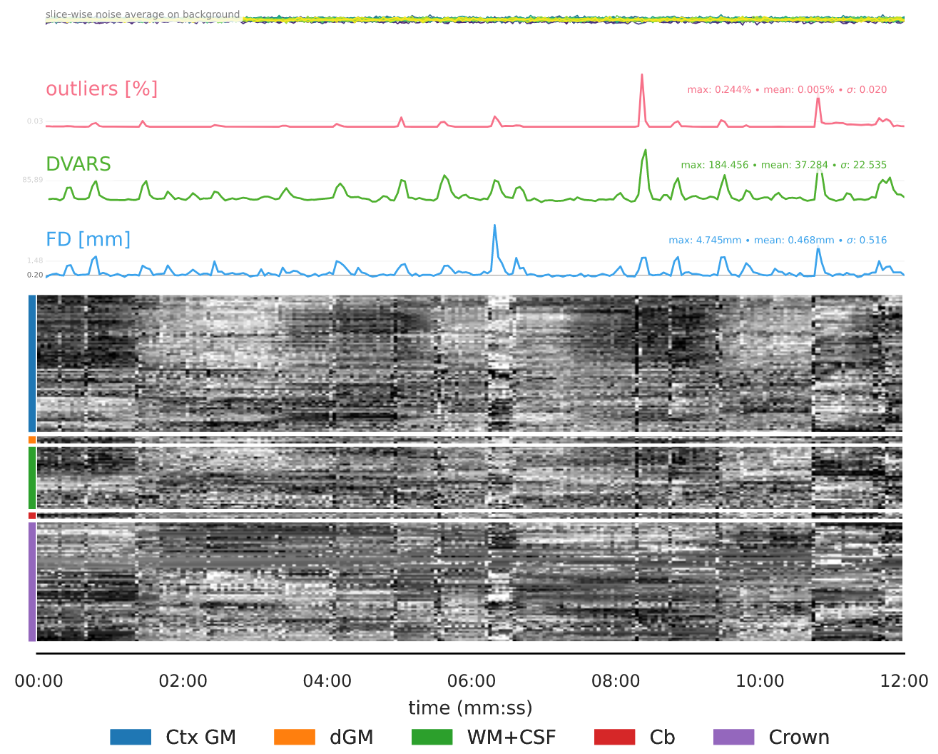
Figure: Example of a carpetplot of a subject with movements
You can also look at the standard deviation map ("Standard deviation of signal through time"). If a subject move a lot between the acquisition of the different volume, the standard deviation will be higher (yellow) around the brain.
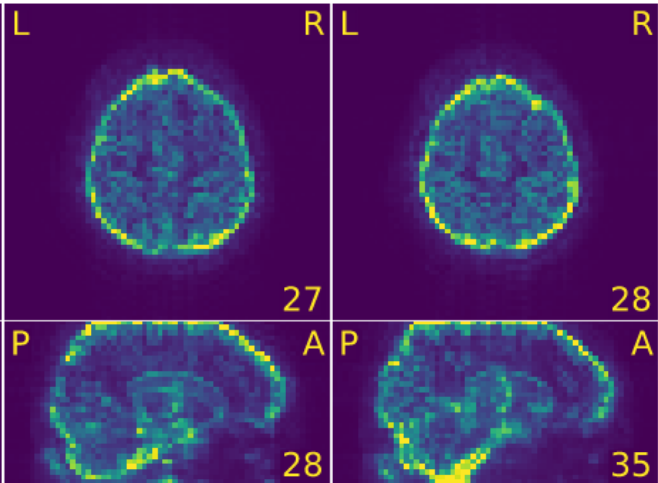
Figure: Example of a standard deviation map from a subject with movements
This map can also be use to check whether eye movements have an impact on the brain (in this case, the variance varies a lot around the eyes and affects the brain).
Note that during pre-processing, it is very common to perform a realignment to correct movement between volumes. It is therefore not necessary to exclude the image below a certain threshold.
F. Aliasing artifact ("phase wrap-around") that impacts the brain
When the size of the object (head) exceeds the defined field of view, an aliasing artefact can be observed (part of the head that is visible on the opposite end of the image).
The aliasing artefact may be visible on the standard deviation map ("Standard deviation of signal through time" mosaic) or on the "average signal through time" mosaic or sometimes on the "view of the background of the voxel-wise average of the BOLD timeseries" mosaic.
The wrap-around artifact is a folding over of anatomic parts into the area of interest (generally more severe along the phase-encode axis).
If the aliasing do not impact the brain, it seems not necessary to exclude the image.
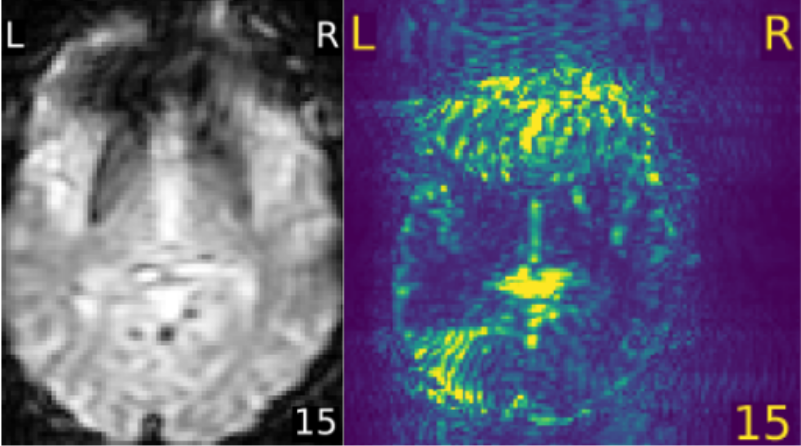
Figure: Example of aliasing visible on the standard deviation map (note that the image quality is already not great)
WIP: ADD OTHER EXAMPLE
G. Nyquist N/2 ghost artifact with an impact on the brain
The background of the image should not contain any visible structures (as there is no BOLD signal in the background). A ghost artefact is a type of structured noise that appears as shifted and weakly repeated versions of the main object, usually in the direction of the phase encoding. These artefacts are often exacerbated by head movement. The Nyquist ghost appears as a faint, duplicate copy of the brain that is shifted by half the field of view in the phase-encoding direction.
Look at the "view of the background of the voxel-wise average of the BOLD timeseries" mosaic. It may also be useful to look at the standard deviation map ("Standard deviation of signal through time" mosaic). If the background artefact is slight and does not spill over into the brain, there is no need to exclude the image.
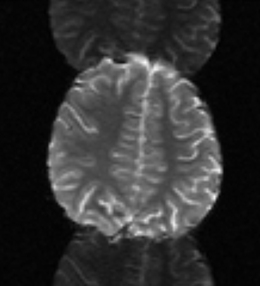
Figure: Example of Nyquist N/2 Ghost Artifact (https://mriquestions.com/nyquist-n2-ghosts.html)
H. Unexpected anatomical anomalies/pathologies not covered by the protocol
Look at the first mosaic in the report.
This may reveal anomalies not anticipated by the protocol (tumour, trace of a stroke).
/!\ Note that it is not the role of a non-medical person to detect anomaly and that it is difficult to "name" the anomaly correctly without special medical training. The aim of this stage is simply to exclude images with anomalies that could cause problems in the subsequent analyses and/or to exclude subjects (for example if we want to make an atlas of healthy subjects). This step is in no way a diagnosis and should not be communicated to the patient without medical advice. In case of doubt, contact the doctor in charge of the study.
I. Other artifacts
Other artefacts may be present and potentially lead to the exclusion of an image. If this is the case, add a note of the problem in the comments section.
Here some examples:
Hyperintense sagittal vertical band on the standard deviation map
The cause of this artefact is not obvious. This does not necessarily mean that the image should be excluded, but it may be useful to ask the MRI physicists involved if they have an explanation (interaction with an element of the 2MRI room during acquisition, etc.).
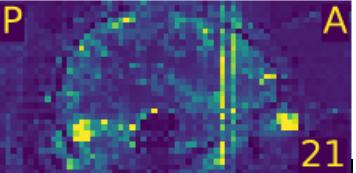
Figure: Example of a subject with hyperintense sagittal vertical band on the standard deviation map
Important signal drift over time.
In fMRI, the signal drifts slightly over time (or a difference between left and right). If this drift is too important (rare) without explanation, the image should be excluded.
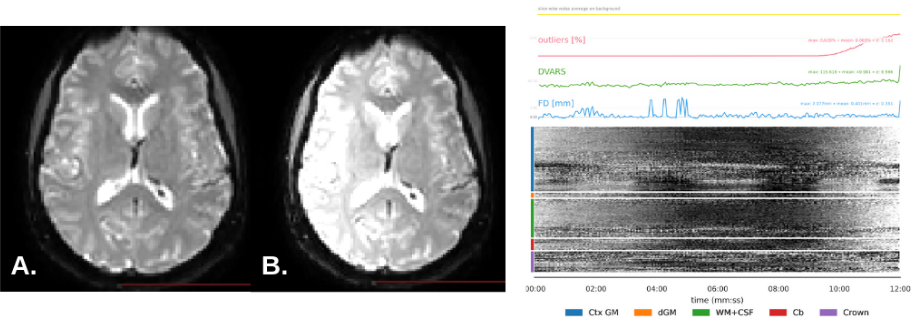
Figure: Example of a subject with a strong change in intensity over time (A. First volume B. Last volume); on this subject there is also a difference between left and right.
Patterns on the standard deviation map
The standard deviation map should not show any particular "patterns". If this is the case, you should talk to the people in charge of acquisitions to understand the cause (sudden movements of the subject, parallel imaging technique, etc.) and possibly exclude the image.
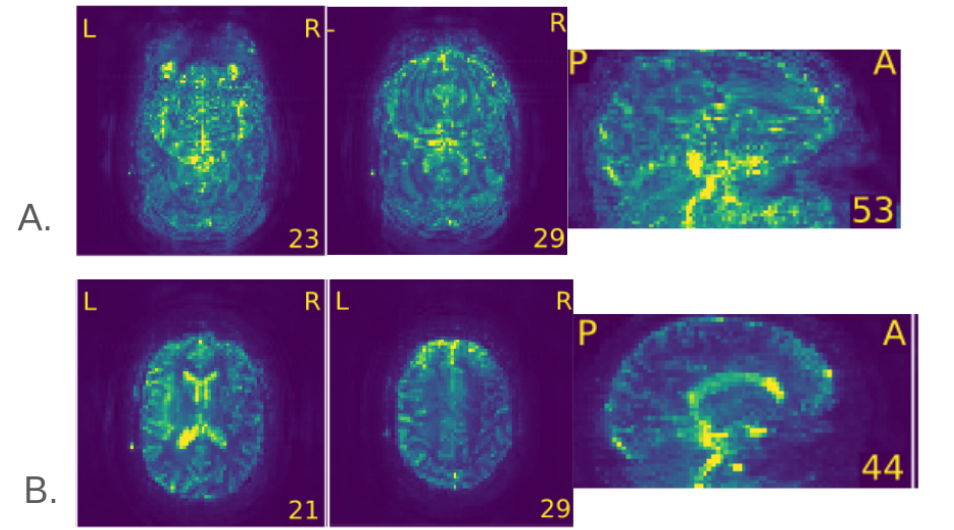
Figure: A: Example of a subject with a pattern on the standard deviation map (here the repetition of the brain, probably because of parallele imaging technique used during the acquisition) B: Example of a subject without artifact on the standard deviation map
"Bright" outliers
The cause of this artefact is not obvious. This does not necessarily mean that the image should be excluded, but it may be useful to ask the MRI physicists involved if they have an explanation (interaction with an element of the 2MRI room during acquisition, etc.).
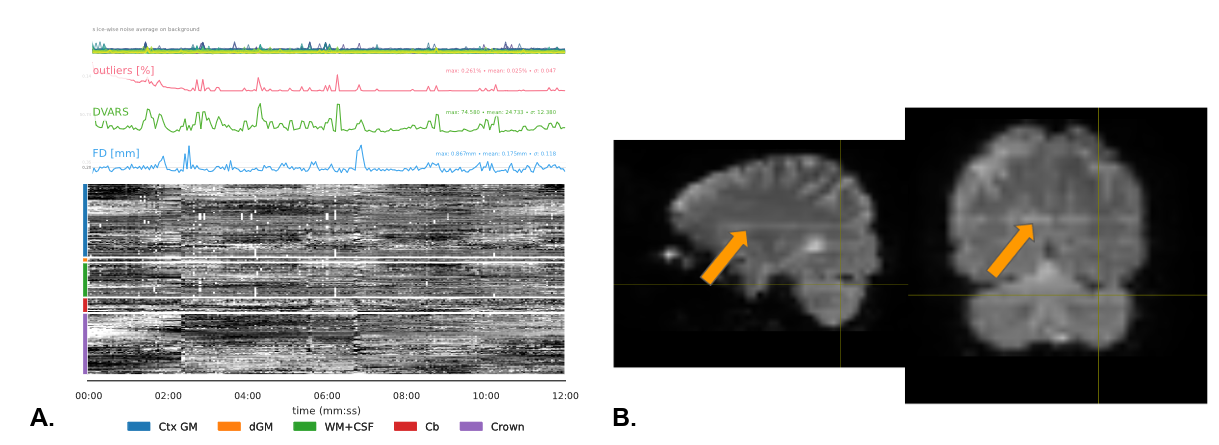
Figure: Example of a subject with "bright" outliers A: Carpetplot from MRIQC report B: Sagittal and coronal plan
Resources
Bibliography (non-exhaustive)
-
A working group on fMRI data quality control. Several research teams proposed articles to show their QC methods and for example:
-
Note that this guide was inspired by this article.
-
-
Automatic quality control:
Software (non-exhaustive)
Quality control of rawdata
- MRIQC: for functional and anatomical data
- VisualQC
- CONN toolbox: possibility to do QC for functional MRI
Quality control of processed data
- AFNI’s afni_proc.py: QC html page with values and images that aid human interpretation of data quality
- fMRIprep: preprocessing of task-based and resting-state fMRI with a report for QC
- CONN toolbox: a Matlab-based cross-platform software for the computation, display, and analysis of functional connectivity in fMRI (fcMRI) with possibility to do QC for each step.
- Qoala-T: A supervised-learning tool for quality control of FreeSurfer segmented MRI data